… in the Minneapolis Star Tribune notes that the most charitable description of what’s been going on at the clubby University of Minnesota medical school would be “bizarre.”
Friday, October 7, 2011

Chickens, Coming Home to Roost...
From the Higher Ed Reporter Alex Friedrich's tweet stream on 10/7/11:
Introducing Howard Bunsis, AAUP officer and prof in accounting at Eastern Michigan U#UMN
Bunsis:#UMN has third-highest in-state tuition among peers, but among lowest for out-of-state students.
Bunsis:#UMN retention numbers are already good -- and very hard to move
Bunsis: Magnitude of state cuts to#UMN -- not debilitating.
Bunsis:#UMN tuition needn't increase as it is. Cuts should be made to growing admin to control costs.
Bunsis: Disturbing that#UMN instruction part of budget went from 26% in 2006 to 23.2 % in 2010. That should never go down.
Bunsis: Many univ. support services that seem tied to instruction are actually admin. If#UMN differs, it needs to fully explain how.
Bunsis: Instructional salaries less than 20% of total#UMN budget.
Bunsis:#UMN has highest % admin spending among peers, but instruct. spending third to last.
Bunsis: Faculty salaries and benefits make up 8.9% of budget at#UM
Bensis: The#UMN attitude of OMG about the financial situation needs to "chill out."
Bunsis: Furloughs, pay cuts were more a political need than a financial one.#UMN needed to demonstrate to leg. that it's sharing the pain.
#UMN finance chief disagrees with Bunsis' use of numbers. Says he inflates admin costs by including those like advisers, libraries, etc.
Fin chief won't say whether he agrees or disagrees with Bunsis' statement that#UMN furloughs, pay cuts were political, not fin need.
The U has a big PR problem (again). Time to get into Morrill Hall and out of Dairy Queens? But I guess a man's gotta eat... Lunch at Big Ten?
No doubt more to come on the final report of Howard Bunsis when it becomes available.
$$$


Thursday, October 6, 2011

Going to Market
At the FCC meeting on September 19, 2011 the Provost explained that the market provides the rationale for differential tuition for the business school. The school will become more competitive by charging higher tuition.
The Provost does not explain how further enriching the professors and the administrators at the business school will make them better teachers or administrators. Are they not giving their best efforts to the students right now? Perhaps the administration hopes that more tuition will enable the business school to hire more "star professors" whose presence will elevate the ranking of the school. That strategy was tried (and failed) at the medical school. See Financial Peril at Medical School.
Moreover, what do rankings really tell us about the quality of teaching in the classroom? The administration acknowledges that the rankings of universities are "meaningless." See the conclusion to section (2) of University Inc. Part II. Does not the same conclusion apply to rankings of schools within the University?
Increasing tuition will make the business school more competitive for the business professors who can increase the gap between their compensation and the compensation of the professors in the liberal arts. For the students it simply makes an undergraduate degree in business more expensive.
The administration describes tuition as "the revenue stream with the highest potential for significant, long term growth." See the September 2009 Report of the Future Financial Resources Task Force (Strategy No. 2 on p. 5 of the Report) (emphasis added). This tone deaf declaration is an expression of an administration that is so far removed from the economic lives of the students and their parents that it is oblivious to the hardship that the current level of tuition imposes on them.
There are alternatives to endless increases in tuition. See Off Course in Higher Education.
Placing more value on a business education also will accelerate the trend of turning liberal arts education into vocational training. See Lowering Higher Education: The Rise of Corporate Universities and The Fall of Liberal Education (University of Toronto Press 2011) by sociology professors James Cote and Anton Allahar of the University of Western Ontario.
The acceleration into vocational training corresponds to the decline in public support for higher education. If higher education is nothing more than preparation for a career, then it makes sense for the public to demand that more and more of the costs for that training be shifted to the students who will benefit from the training. This approach turns higher education from a common good into a private enterprise. See University Inc.
Michael W. McNabb
Attorney at Law
This contribution comes from my good friend and fellow U of M alum, Mr. Michael McNabb. He has also paid a lot of tuition for his children at the U. Thank you Michael.
$$$
Wednesday, October 5, 2011

When Professor Shechtman first made this discovery, it was met with much skepticism. It really was a jaw-dropping discovery that put him under intense pressure. Even Pauling did not agree with his interpretation and proposed alternative models for the diffraction patterns Shechtman first observed for quasi-crystals.
A wonderful story for denialists (climate, evolution...) and anti-scientists.
Mazel tov, Professor Shechtman.
+++

Sunday, August 21, 2011

University of Inefficiency?
Internal critics are calling out administrative bloat at various levels of the University of Minnesota.
The Minnesota Daily has an excellent piece from which this post title is taken.
There may also be found some enlightening comments from two faculty members.
Bill Gleason
This topic has been of long term interest on my blog, The Periodic Table. A subject that the Bruininks' administration consistently tried to blow off or ignore. But a serious problem that it will be necessary to face in the new Kaler administration.
For some background:
On Skyrocketing Administrative Costs at the University of Minnesota
Link: http://bit.ly/f5BdDf
On the cost of Administration at the University, Part II
Link: http://bit.ly/gMvSWj
University Inc.
Link: http://bit.ly/adAmY0
University Inc. Part II
Link: http://bit.ly/hXlCBy
Steen Erickson
Tell me of an organization of any size that doesn't have at least some waste or inefficiency and I'll tell you you're making it up. You simply can't build any organization staffed with human beings that won't have some problems - and Sviggum's list of "possibilities" for redundancy is utterly ignorant. When people like Sviggum focus on perceived or implied problems as evidence of some sort of a culture of waste or other sinister intent, I would ask them to hold up a mirror and let their own organizations, past and present, be examined for any sign of "impropriety." You'll find it if you aren't wearing your tea-party-lens glasses.
This is an excellent institution and I would argue that the majority of faculty and staff want it to succeed. The U contributes/creates intellectual capital to our society, providing opportunities for innovation and invention, and hopefully opportunities to improve our future. Can the same be said for many of the large corporations that many of Sviggum's allies would have us outsource to at the federal, state, or local level? (no, it can't - at least not if you're actually paying attention)
Support the University. Demand accountability, sure, but understand what we're here for and invest in our future. It's the future of our society. Maybe hire some folks who are perhaps a bit more effective at rebutting the critics? (a Frank Luntz for our side?)
Bill Gleason
You seem defensive, Steen, and blind to what has gone on here for the last ten years. As for hiring more folks who can rebut critics I point to people like Dan Wolter, Justin Paquette, and their army of spear carriers in the PR department.
Plenty of critics are both supporters of the U and not members of the Tea Party.
"I am not now, nor have I ever been, a member of the Tea Party."
Bill Gleason
U of M faculty member and alum (Chemistry, 1973)
Steen Erickson
Not entirely defensive and blind, Bill, but perhaps more tolerant (OK, that's probably a pretty big stretch!). Not tolerant of waste, but recognizing that organizations are imperfect. Most things exist in living color, not black and white.
I do think the University needs better oversight, and I know from experience that effective oversight comes from effective managers. But the "administrative bloat" meme that has become popular among some folks is, I believe, nothing more than a catchy phrase that is easy for some to wrap their heads around even though it lacks substantive backing. A list of high paid "administrators" isn't proof of bloat. Functions and effectiveness need to be evaluated before "bloat" can be asserted.
I'm far too idealistic, I know, but I'd like to see a reasoned, fair evaluation of the areas of "bloat" to determine whether or not they actually add value, and particularly whether they add value that exceeds their cost.
Being that this is an institution of creative, intelligent people, do you think "we" have the capacity to do this evaluation? I won't hold my breath, but I am marginally hopeful...
Oh, and the tea party reference really alludes to the uninformed, catch-phrase driven folks who don't know enough to ask the meaningful questions.
Not entirely germaine to your post, but hopefully marginally clarifying.
Bill Gleason
Thanks, Steen.
I'm happy to talk specifics about administrative bloat. See for example my piece on the Periodic Table: “Cost Effectiveness is a Sometime Thing.” link: http://bit.ly/cdfSHN
I'll note that Dr. Roberta Sonnino, a close personal friend of a former med school dean, has now flown the coop at the U of M. This was announced, no doubt deliberately, on the Friday before July 4th weekend. She replaced an Associate Dean who was half-time. Dr. Sonnino's position was full time at a cost of ca $260,000. She went about busily trying to pump this position up to a full time job. See: The Latest Craziness in the Medical School - Or, Sunlight Is The Best Disinfectant link http://bit.ly/qMLkas
The current dean of the med school has announced that Dr. Sonnino's position will be filled at the half-time level. “Cost Effectiveness” also lists some other administrative fat. Mentioned there is one Dr. Henson, who has also hit the trail after much unhappiness by the faculty over her re-engineering the med school teaching function. The administration and the operation pushing homeopathy in the Academic Health Center/Medical School could also be easily disposed of. It is a waste of money. See my piece in the Chronicle of Higher Education: Why Would an Academic Health Center Support Homeopathy? link: http://bit.ly/ea9qNI See also the shamefully weak response by Dean Friedman and former Dean Cerra that doesn't even mention the word homeopathy. link: http://bit.ly/goqI79
Ka-ching!
The organizational structure of the Medical School with Dr. Aaron Friedman serving as both dean and VP of the AHC actually leads to further administrative bloat. Dr. Friedman obviously can't do both jobs himself so further levels of administration, particularly in the medical school, are necessary. Even though the medical school faculty voted overwhelmingly for a dedicated dean, this farcical and expensive administrative fiasco persists. See: Faculty Governance at the University of Minnesota is an Oxymoron, link: http://bit.ly/aCgOGi
Ka-ching!
A lot of this kind of stuff has gone on over the last ten years, Steen. Any administrator, short of the president, who needs a “chief of staff” has too many people working for them. And I won't even mention refugees being hired from the Pawlenty administration in hopes that they could pour oil on troubled waters.
Ka-ching!
One might also well ask why we needed a “cultural czar,” vp Rosenstone's position after he was booted upstairs from being CLA dean. Of course a czar needs a palace and a staff. It will be interesting to see if a new “cultural czar” is appointed, now that Rosenstone is busily turning MNSCU into a world class operation.
Ka-ching!
President Kaler has a lot of work to do. I trust he's up to the task.
We can be one of the best schools in the Big Ten, Steen. We have the students and faculty. If we just had a competent administration over the last ten or so years...
The legislature will buy into the U when we show that we have our act together.
My best,Bill
Friday, August 12, 2011
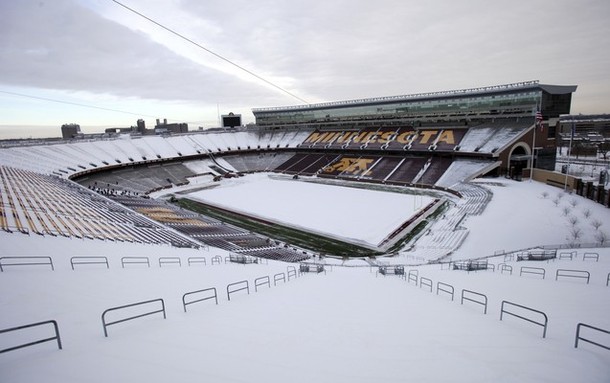
Twin City Federal Stadium - University of Minnesota
EXPENSIVE ICING
Judith Martin, a longtime geography professor and faculty leader at the U explains the plan [of President Bruininks] in this way: “The biggest way you can improve your rankings is to graduate students in four years and buy yourself a couple of Nobel-winning profs, right? Takes care of everything else. If your football team can win, that’s icing on the cake.”
The strategy of buying “star professors” did not work at the Medical School. See Financial Perils at Medical School.
And a big time athletics program is expensive icing.
In fiscal year 2009 the U of M ranked No. 20 in the nation in expenditures on athletics at $70.3 million. (The University of Southern California ranked No. 10 at $80.2 million.) See Table 1.1 on p. 18 of Big Time Sports in American Universities (Cambridge University Press 2011) by Duke University economics professor Charles Coltfelter.
The color of the financing is red:
Yet again, nearly every Division I athletics program spent more than it made last year. . . . The [NCAA] report, released Tuesday, presents a bleak financial picture of intercollegiate sports and reinforces critics’ charges that the current pattern of sports spending is unsustainable.
Only 14 programs [out of 120] from the Football Bowl Subdivision (formerly Division I-A) generated more revenues than expenses. This is down from 2006-07 and 2007-08 when 25 programs turned a profit. . . .
In a similar vein, the median institutional subsidy for athletics in the FBS rose from around $8 million in 2007-08 to more than $10 million in 2008-09. This reliance on institutional funds has increased as the growth in median revenue generated directly by athletics programs in the FBS—via sources such as ticket sales and media contracts—slowed to nearly 6 percent from 2008 to 2009. This is down significantly from the 17 percent growth in revenue from 2007 to 2008. By comparison, total athletics expenses sped in the other direction—ballooning by nearly 11 percent. This is double the growth in expenses from 2007 to 2008.
Up,Up and Away, the August 18, 2010 report in Inside Higher Ed (emphasis added). See also the 2010 report of the Knight Commission on Restoring the Balance: Dollars, Values, and the Future of College Sports.
The athletic department at the U of M continues to receive annual multi-million dollar subsidies from the general fund of the University (the Operations & Maintenance Fund). In fiscal year 2010 the subsidy was $8 million; in fiscal year 2011 the subsidy was $7.8 million. See pp. 77, 81 of the U of M budget. Meanwhile, the administration continues to cut courses and faculty positions and to replace professors with part-time instructors without tenure. See Section 1 of $tate of the University—A Parent’s Perspective.
Then there are the continuing direct and indirect costs for the construction of a $288.5 million football stadium that will be used for six games each year. See Section 5 of University Inc. Part II.
There is a solution that would enable the University to disentangle itself from the big business of the major revenue sports while allowing those programs to continue. The football and basketball teams should be organized as separate corporations. The University would grant a license to those corporations to use the University name for the teams. The license fee would be a percentage of the revenues generated from ticket sales, broadcasting rights, advertising, etc. The license fee income would be used to support the non-revenue sports that the University decides to retain, such as track and swimming. This is a solution that would enable the fans to continue to enjoy the games and would enable the University to focus on education, research, and public service—the reasons for its existence.
Michael W. McNabb
University of Minnesota B.A. 1971; J.D. 1974
University of Minnesota Alumni Association life member
Thursday, August 11, 2011

On the Mismanagement of Academic Facilities at
The University of Minnesota
My friend and fellow U of M alumnus, Mr. Michael McNabb writes:
Higher Education Preservation and Replacement funds are used to repair existing academic buildings. The administration asserts that since 2002 it has emphasized HEAPR bonds in its biennial Capital Request to the legislature in order to demonstrate its commitment to maintain existing academic facilities. The report includes a table to illustrate that the administration "tripled its average biennial HEAPR request and quadrupled its average award" between fiscal year 2002 and fiscal year 2009. See p. 22 of the June 2011report of the President on Financing The Future.
That is the most positive way to describe the situation. The table shows that since 2002 the administration has requested a cumulative total of $385 million in HEAPR bonds. The legislature has awarded $178 million, less than half the amount requested by the administration. Assume that the administration requested amounts that were in fact necessary to maintain the existing academic facilities. This would tend to indicate that at least part of the academic infrastructure is at risk of beginning to crumble. (The construction of a new football stadium and new academic facilities, such as the Biomedical Discovery District, may shift the spotlight away from the condition of existing buildings.)
The alternative explanation is the administration intentionally inflated the request for HEAPR bonds in an attempt to obtain a lesser amount that was actually necessary. Such a legislative strategy would have the potential, of course, to destroy the credibility of the University at the Capitol. See Resolution No. 1 in New Year's Resolutions for New President.
So which explanation is accurate? In May 2011 the Legislative Auditor announced that he will evaluate facilities management at the University. In his announcement the Auditor notes:
In 2010 the University requested $100 million in HEAPR funds and received $56 million. University officials state that there are far more maintenance and repair needs than there are funds available for maintenance work. . . .
The University's Facilities Management Division uses a Facilities Condition Assessment (FCA) to evaluate the conditions of all facilities and prioritize projects by needs. An analysis of University maintenance in 2010 found that the University had a much higher (and increasing) backlog of maintenance needs than peer institutions. . . .
OLA evaluations in 1988 and 1991 on routine maintenance on the Twin Cities campuses found that there was not effective planning for preventive maintenance.See the May 2011 Notice from the Auditor (emphasis added).
Michael W. McNabb
Attorney at Law

Professor Butt and the Self-Opening Napkin
Did Rube Goldberg Design
the University of Minnesota
Administration?
My friend and fellow U of M alum, Michael McNabb writes:
Note:
Rube Goldberg's cartoons became well known for depicting complex devices that performed simple tasks in indirect, convoluted ways. An example on the right is Goldberg's "Professor Butts and the Self-Operating Napkin", which was later reprinted in the postcard book, Rube Goldberg's Inventions!, compiled by Maynard Frank Wolfe from the Rube Goldberg Archives.
The "Self-Operating Napkin" is activated when the soup spoon (A) is raised to mouth, pulling string (B) and thereby jerking ladle (C) which throws cracker (D) past parrot (E). Parrot jumps after cracker and perch (F) tilts, upsetting seeds (G) into pail (H). Extra weight in pail pulls cord (I), which opens and lights automatic cigar lighter (J), setting off skyrocket (K) which causes sickle (L) to cut string (M) and allow pendulum with attached napkin to swing back and forth, thereby wiping chin.
In 1931, the Merriam–Webster dictionary adopted the word "Rube Goldberg" as an adjective defined as accomplishing something simple through complex means. Wikipedia
From the July 14, 2011 report of the Faculty Consultative Committee on the U of M administration:
It was clear that all of them [vice presidential units] are very complicated organizations.page 1, paragraph 2 of the FCC report.
In addition, many of the vice presidential units have centers or programs or institutes that may or may not be especially closely related to the mission of the unit. . . . It appears to the SCFP that at least some of these organizational units continue without any review or any sunset provisions.page 1, paragraph 3 of the FCC report.
There was discussion in SCFP about where administrators are, and it may be that there are more in the colleges than in central administration. But it would be a massive job to evaluate the administrative activities in each of the colleges.page 2, paragraph 5 of the FCC report (emphasis added).
So the administration has grown willy-nilly over the years to the point where no one now understands the organization or even knows where all the administrators are! (Perhaps too big to understand is a corollary to too big to fail.)
Then consider the words of vice president and chief financial officer Richard Pfutzenreuter at the April 5, 2011 meeting of the Senate Committee on Finance & Planning:page 2, final sentence of the April 5, 2011 report of the SCFP at http://conservancy(emphasis added).Mr. Pfutzenreuter responded that his office is working on identifying what pays for research, education, public service, financial aid, and so on, based on the attribution of both direct and indirect costs, in order to determine the "fully loaded" costs of instruction and other mission activities.
So while building an incomprehensible organizational framework, no one has been keeping track of the flow of non-restricted funds.
Michael W. McNabb
Attorney at Law
 |
| They came from Rochester... |
Mayo Muscles in at the Mall of America
The body (patient) snatchers are slowly moving North. They've built an oncology center in Northfield, and are now at the Mall of America with options to build in the future.
And of course they might in the future simply buy one of the Twin Cities hospital chains. There are two ways to look at this. On the one had you could feel sorry for the local hospitals being squeezed by Mayo.
Or on the other hand you could say that ultimately it is for the good of the patients since Mayo is a superior operation.
A Mayo invasion is also partially the fault of greed and stupidity of the local hospitals, including Fairview/University of Minnesota. One need only look to the children's hospital situation for an example of greed, waste, and inefficiency.
See for example: Fairview Layoffs, Did new children's hospital at U of M have anything to do with this? and links therein.
Mayo Opening High-Tech Outpost at Mall of America
The internationally known medical center based in Rochester gave reporters a peek at its "Create Your Mayo Clinic Health Experience" the day before its opening. The facility sports three-dimensional computer monitors, kiosks for the casual shopper and "navigator" specialists to help people assess their health and map out a wellness program.
"We consider this a lab as we try to decide what we want to offer in a permanent facility, if we do that," said Dr. David Hayes, medical director for the mall project.
The idea is to gather customer and patient opinion to guide development of a facility Mayo would like to build in the Phase II expansion of Mall of America, officials said.
Mayo has been creeping closer to the Twin Cities market in recent weeks. Last month, Mayo Clinic Health System, which has 70 medical facilities in the Minnesota, Iowa and Wisconsin, acquired the former Queen of Peace Hospital in New Prague. That Scott County hospital has three branch clinics in Belle Plaine, Le Sueur and Montgomery.
Also in July, Mayo opened a $10 million oncology treatment center in Northfield, near the campus of Northfield Hospital.
"We are not competing," said John La Forgia, Mayo's chief marketing officer and a project strategist. "We have something unique. This is about health and wellness, not the kind of service provided by a hospital. ... We are not developing a major new hospital."
But anyone stopping at the mall can easily connect with Mayo doctors and resources in Rochester, Hayes said. Mayo has a two-year lease on its first-floor space and on a more traditional office nearby.
Standing by a computer monitor in one of the three traditional exam rooms, Hayes explained the Rochester connection. By using video technology, doctors in Rochester can get the pulse or blood pressure of a patient in the mall medical office. The doctors can see video of a skin lesion or other symptoms and diagnose conditions with some assistance from a medical worker at the mall office, he said.
La Forgia declined to put a price tag on the mall project cost or what kinds of revenue its expects to generate there. Patients would typically pay for mall services out of pocket, he said.
Mayo has a letter of intent with the Mall of America giving the clinic first choice of a space in the upcoming mall expansion, he added.
"We would like to do it, but there is no commitment that we will definitely do it," he said.
Mayo has retained the Campbell Mithun advertising agency to publicize its new venture, La Forgia said. Mayo is also the only provider allowed to offer health fairs or any other health-related activity at the mall for two years, Hayes said.
"This is a global destination," La Forgia said of the mall. "We think of ourselves globally."
"We talk to people at the mall and at other malls and ask, 'What would you want?'" Hayes said. "This is a lab to find out what will work in this space [and] to keep Mayo relevant and give people more information about their health and wellness using high quality materials."
Wednesday, August 10, 2011
It's an old song...
Administrative Bloat at the University of Minnesota
This topic has been of long term interest here at the Periodic Table. A subject that the Bruininks' administration consistently tried to blow off or ignore. But a serious problem that it will be necessary to face in the new Kaler administration.
For background:
University of Inefficiency?
There are too many administrators and they’re overpaid, he says. Messing, a University employee for 30 years, has an extreme view on an issue that’s heating up as the school finds itself in a budget crisis.
A Minnesota Daily analysis of the Twin Cities campus salaries shows 51 top administrators, from assistant vice presidents to the president, were paid more than $10 million in the 2010 fiscal year — an average of about $200,000 per administrator
In the past, the state Legislature has brought up questions of administrative efficiency. But it was the presidential transition, from Bob Bruininks to Eric Kaler, that triggered a review of the central administration now, said University Senate Committee on Finance and Planning member Terry Roe.
The committee’s basic conclusion: “There appears to be considerable duplication of functions within the University,” according to a report draft obtained by the Daily.
In the draft of the SCFP report, committee chairman Russell Luepker wrote that many units within the University have their own public relations staff, as does the central administration.
The report also points out the volume of “centers, institutes and programs” within units, and that “some may continue to play vital roles but others do not.”
Luepker prefaced the report by saying it doesn’t focus on individual units because each has its own mission and activities. “Nonetheless, there are generalizations that can be made and should be considered,” he writes.
Professor Eva von Dassow visited the SCFP in 2010 to express frustration with the University’s spending.
In requesting an audit of the administration, von Dassow said it would “establish a new norm in faculty-administration relations” in the time leading to the presidential transition, according to meeting minutes.
Regent Steve Sviggum, who had served as the Republican Speaker of the House in the state Legislature before joining the Board of Regents, said government is top-heavy, but higher education is worse.
Throughout private and public industry, productivity has increased along with efficiency, Sviggum said. And while the University has been producing more with more students, its efficiency has lagged.
Sviggum requested University employment numbers after becoming a regent in February. Those figures showed a 50 percent increase in professional and administrative staff over the past decade, he said.
“Does every school need its own communications staff?” he asked. “Does every school need its own fundraising staff? Does every school need its own … human resources staff?”
Sviggum said fellow regents Laura Brod and Dean Johnson have brought up similar concerns.
“When you start looking at aggregate, the number and the salaries, and then the assistants and the legislative assistants, you have to start shaking your head a little bit,” Sviggum said.
Messing said the result of the SCFP’s review should include both trimming salaries of overpaid administrators and axing unnecessary positions. He said the “bloated” administration can impact students in far-reaching ways, like tuition hikes.
“You lower the tuition and you get more scholarship money and there are many ways of doing this, at least starting to do this,” he said. “Cut the administration by 50 or 60 percent. Give the money you save to students.”
“From my perspective, the administrator making $250,000 a year is worth far less than the man who cleans the toilets. One does an honest job..."
Kaler said he’s sure there are ways to make the University more efficient but recognizes the importance of some administration.
“We have a $3.7 billion budget, so managing that effectively means that you’re going to have some administration.”
Luepker said in an email that he expects the SCFP report to be finished in the next month.
Monday, August 1, 2011

Does the Medical School at the University of Minnesota
Have no Shame?
Although I apologize to gentle readers for putting this trash up, there is no other way that I can properly express my disgust for the University of Minnesota and its Medical School's acceptance of money from a porn purveyor.
Please see my post on the Chronicle of Higher Education Brainstorm Blog:
When asked about hardcore porn – something that’s believed to distort a person’s view of sexuality, Eli Coleman, director of the university program on human sexuality replied:
“If this was a company that was into child pornography or something like that, that was illegal, I don’t think we could morally accept something from people who are involved in illegal activities. But this is a company that’s responsible and is law-abiding…”
It is a sad day at a university when the ethical standard is: “If it is not illegal, we can do it.”
Saturday, July 30, 2011
$tate of the U - A Parent's Perspective
___

This post is available in pdf format.
To view pdf. (Opens in Google Documents)
To download, select "file" option at top left.
My friend and fellow alum, Michael McNabb writes another important guest post that is well worth reading by parents of prospective University of Minnesota students. His prior essays on our university have been major contributions to framing the debate on the crucial question: What do we want for our University?
President Bruininks gives the perspective of the administration on the state of the University in his correspondence of June 14 to Regent Steve Sviggum. Here is the perspective of a parent of four children who have received their undergraduate or professional degrees (or both) from the University since 2004.
(1) The President acknowledges that during the past 10 years the budget of the University has increased by $1 billion. Yet the administration is cutting courses and faculty positions. See Three Minutes at http://ptable.blogspot.com/2010/06/three-minutes-of- input-at-university-of.html# links. And the administration plans to continue the elimination of academic programs and the replacement of professors with part-time instructors without tenure. See Recommendation No. 4 (Narrow the Scope) at pp. 8, 33-34 of the June 2011 report of the President on Financing The Future at http://blog.lib.umn.edu/pres/ news/June2011_TtU_ CostProductivity_FINAL.pdf.
During the same period the administration has displayed no mercy toward the students and their parents as it raised tuition at dizzying rates. See Stop Using Students as ATMs at http://ptable.blogspot.com/2010/10/stop-using-students- as-atms-university.html#links. The administration increased tuition so substantially that it more than offset the reduction in state appropriations. Hundreds of millions of dollars of tuition flowing into the coffers each year together with hundreds of millions of dollars in state appropriations enabled the administration to increase its budget by $1 billion. (In the current fiscal year the administration will rake in $808.3 million in tuition. See the President's Operating Budget at p. 26 of the June 20, 2011 report of the Board of Regents at http://www1.umn.edu/regents/ docket/2011/june/board620.pdf. )
The administration plans to continue using students and their parents as ATMs with endless reservoirs of money. A recent report declares that "tuition is the revenue stream with the highest potential for significant, long term growth" and asks "what should tuition pay for when tuition revenue exceeds the cost of instruction." See the link to the 2009 Report of the Future Financial Resources Task Force in On The Hidden Cost of Research at http://ptable.blogspot.com/2010/12/on-hidden-cost-of- research-michael.html#links; see also Recommendation No. 2 (Grow Tuition Revenue) at pp. 7, 51-52 of Financing The Future.
This double whammy inflicted by the administration means that students and their parents now pay much more while the scope of the education available is reduced and the actual teaching of students is increasingly assigned to part-time instructors (or, cheaper yet for the University, to on-line instruction).
"The real issue is increasing the value that we the university bring to the state of Minnesota, to its stakeholders and to our students. Increasing that value, communicating it and demonstrating it will be the major goal of my presidency."
President Eric Kaler in the July 7, 2011 issue of the Pioneer Press at http://www.twincities.com/ci_18423950 (emphasis added).
(2) The President claims:
Net Price for Twin Cities undergraduates has increased an average of 3.4% per year over 10 years.
See p. 59 of his report on Financing the Future (emphasis added). Let us examine the calculation of Net Price:
The cumulative percentage increase per student, 2001-2010, in Cost of Attendance, grant/gift aid, and Net Price were quite different from the increase in tuition sticker price, Dr. Radcliffe explained. The cost of attendance increased by 50% during these ten years; the Net Price increased only 34%. The primary reason that the Net Price is increasing more slowly than the Cost of Attendance is because of significant increases in the size of the mean grant/gift award. The Net Price, he said, is tuition minus financial aid. His focus is on the net price; while the sticker price is relevant for some students, it is not for most.
See p. 5 of the June 7, 2011 report of the Senate Committee on Finance & Planning (emphasis added).
The administration includes student loans in its definition of "total financial aid." See the definition under the heading "Improvements in Financial Support" on p. 12 of the report of the Provost entitled Achieving Excellence at http://www.academic.umn.edu/provost/reports/documents/ Achieving_Excellence_2005-10.
So the calculation of Net Price by the administration does not reflect the economic reality facing the students (and their parents). It subtracts (disregards) the amount of the student loans that the students and parents will be paying off for years to come.
See the response of the Minnesota Daily at Cynical & Deceptive at http://ptable.blogspot.com/2011/03/minnesota-daily-nails- university-of.html#links.
See also Student Debt at http://ptable.blogspot.com/2009/10/college-of-liberal- arts-dean-vision-of.html#links
(3) The President claims that there will be 74 senior administrators at the end of the 2010-2011 academic year. He defines senior administrators as the president, vice presidents, provosts,chancellors, deans and a few others. See p. 5 of his letter and note 6 in Financing The Future.
The Pioneer Press has a web site for Minnesota Public Salaries. There is a link to the site in On The Cost of Administration at http://ptable.blogspot.com/2011/03/on-cost-of-administration-at-university.html#links. The web site lists 9 provosts, 18 chancellors, 40 vice presidents, and 112 deans. The site identifies the persons who hold those senior positions. The number claimed by the administration is not even close to being accurate. There are scores of administrators who receive hundreds of thousands in dollars in compensation each year.
In his letter the President does not discuss the compensation of the senior administrators. At the legislature he defends the compensation as within market range for such positions. This is the same justification used to pay tens of millions of dollars in annual bonuses to Wall Street executives. The President and the Regents may have an unwavering confidence that the market always makes the correct determination in economic matters. Alan Greenspan did when he was chair of the Federal Reserve, as did the "Masters of the Universe" who were the chief executive officers of the Wall Street firms. Their misplaced confidence combined with greed to bring our national economy to the brink of chaos.
The law restricts the pursuit of personal wealth by the leaders of a tax-exempt organization (such as a non-profit institution of higher education). Among other measures, the Internal Revenue Code imposes an excise tax on excessive compensation paid to senior executives. See the Postscript below. Is the annual compensation of hundreds of thousands of dollars to scores of senior administrators at the U of M reasonable when students must incur tens of thousands of dollars in debt that will take years to repay in order to support that level of compensation?
Conclusion
Our system of higher education has contracted a malady that plagues our health care system. The cost of health care in the United States is much higher than it is in any other country (whether measured as per capita spending or as a percent of GDP). A major reason for this high cost is that our for-profit health insurance companies have by far the highest administrative costs in the world. See T.R. Reid, The Healing of America pp. 34-43, 229 (New York: Penguin Press 2009).
Each year hundreds of billions of dollars flow through each system. The issue is not a lack of funds. The issue is the allocation of those vast sums of money. See University Inc. Part II at http://ptable.blogspot.com/2011/02/draft-as-university- transforms-itself.html#links .
Postscript
The law restricts the pursuit of personal wealth by the leaders of a tax-exempt organization (such as a non-profit institution of higher education):
See pp. 2-3 of the IRS Compliance Guide for 501(c)(3) Public Charities (Publication 4221-PC) at http://www.irs.gov/pub/irs-No part of [a tax-exempt] organization's net earnings may inure to the benefit of an insider. An insider is a person who has a personal or private interest in the activities of the organization such as an officer, director or key employee. This means that an organization is prohibited from allowing its income or assets to accrue to insiders. An example of prohibited inurement would include payment of unreasonable compensation to an insider. Any amount of inurement may be grounds for loss of tax-exempt status .pdf/p4221pc.pdf (emphasis added).
Section 4958 of the Internal Revenue Code also provides for an intermediate sanction that may be imposed on executives of tax-exempt organizations who receive excessive compensation:
Congressional hearings in 1993 produced several outrageous instances of excessive compensation. Though the existing federal law could penalize an organization by removing recognition of its tax exempt status, the IRS rarely, if ever, imposed such a penalty, for the removal of exemption was like hanging someone for stealing a loaf of bread. It was too draconian for the wrong, and it hurt the organization rather than the individual who engaged in the private inurement. In response to this problem, Congress adopted the approach of the private foundation rules, imposing a graduated excise tax on "excess benefit transactions" involving 501(c)(3) and 501(c)(4) organizations other than private foundations, a so-called intermediate sanction that replaced the ultimate penalty of revocation of tax exemption.
Fishman, Wrong Way Corrigan and Recent Developments in the Non-Profit Landscape, 76 Fordham L. Rev. 567, 585 (2007) at http://ir.lawnet.fordham.edu/flr/vol76/iss2/3. (Click on download in the right hand column.)
In 2005-2006 the IRS conducted a compliance check on executive compensation in tax exempt organizations. Although high compensation was usually determined to be appropriate, the IRS did assess $21 million in excise taxes against 40 executives in 25 organizations on the basis of excessive compensation. See p. 1 of the March 2007 IRS Report on Exempt Organizations Executive Compensation Compliance Project at http://www.irs.gov/pub/irs-tege/exec._comp._final.pdf.
In October 2008 the IRS commenced a compliance check on tax-exempt colleges and universities. Executive compensation was a major area of inquiry. The IRS requested information on the compensation of the six highest paid officers, directors, trustees, and key employees (ODTKEs). The IRS survey included 91 large universities. The average compensation of the highest paid ODTKE at large universities was $428,000 while the median compensation was $361,000. See Figure 65 on p. 55 of the May 2010 IRS Interim Report on Tax-Exempt Colleges and Universities Compliance Project at http://www.irs.gov/pub/irs-tege/cucp_interimrpt_052010. pdf.
Over the past several years the compensation of President Bruininks was an annual salary of $455,000 plus an annual contribution of $150,000 to his retirement account. The compensation of President Kaler will be an annual salary of $610,000 plus an annual contribution of $50,000 to his retirement account starting in his second year.
Michael W. McNabb
University of Minnesota B.A. 1971; J.D. 1974
University of Minnesota Alumni Association life member
___

University Enterprise Laboratories (UEL)
Declared Dead by MedCity News
The fiasco that is University Enterprise Labortories has been discussed before on this blog. For background, please see: University Enerprise Laboratories - A Wild Success or a Failure?
Finally time to stick a fork in it?
Minnesota ‘biotech incubator’ UEL has failed. It’s time to admit it
During the past six years, UEL has portrayed itself as a biotech incubator helping the University of Minnesota’s technology transfer efforts. But, for the most part, the university has been propping up what is a textbook case of how not to start an incubator.UEL picked too big of a space in the wrong kind of building. It carried large debt from inception. And when the university didn’t create enough startups, UEL gave space to anyone in order to stay afloat. What’s more, UEL never tracked key metrics, like job creation, from startups that did flourish under its care.
It failed from the start
UEL started in 2004 with $13.8 million in debt and an expectation that companies created from University of Minnesota’s technology would rent much of its 126,000 square feet.
But the university didn’t produce enough startups. So there were few renters and little revenue. In fact, in 2008, as UEL’s very survival became a question, it laid off its general manager and an administrative employee. It saved itself by renting to whatever company would take space.
“We were left scrambling to fill this building in one way or another so as to service the debt that we were up against,” said Anthony Carideo, UEL’s chairman.
Now, many of UEL’s roughly 30 tenants have nothing to do with biotech or life sciences.
It’s on welfare
... cash on hand ($378,806 as of December 2010) would be wiped out if the university enforced a requirement for UEL to pay a fine if it did not provide space to school startups. The university has waived that every year since 2006 — the first year the payment was due.
The cumulative tab to date? $500,000.
“At a time when that whole operation was just getting off to a start, it would have been I think (unfair) for us to say we hold you responsible for the fact that we didn’t spin out enough companies to locate there,” said Tim Mulcahy, vice president of research at the University of Minnesota.
Over the years, the university and its foundation provided $3.75 million to UEL, with the foundation also extending a $750,000 line of credit, Carideo said.
It didn’t do the math
George also said the success of an incubator shouldn’t be defined by operational cash flow. That’s because the goal of the incubator is to provide subsidized facilities and services to startups — not in generating profit.Instead, success should be defined by the number of jobs the incubator has helped to create, George said.
UEL has had four graduates — Segetis, Twin Star Medical, Harland Medical Systems and OrthoCor Medical — but it has never tracked jobs it helped create.
University support is inconsistent
Last year, the school’s Medical Devices Center was teaming up with UEL to create what would be tentatively known as the Medical Devices Center Launch Pad. The space would house early stage companies created through a fellowship program at the Medical Devices Center.
But the head of the university’s technology commercialization office apparently shot the idea down. “It was an innovative, collaborative idea developed by good-hearted folks, implemented in start-up speed, without buy-in from U of Minnesota leadership,” stated Marie Johnson, the former director of the Medical Devices Center’s Innovation Fellows program.
In the future, could it become a biotech incubator? Yes. If it manages to lower its rent, kick out some tenants and bring in someone with tech transfer expertise to run it. But Carideo did not seem particularly open to the idea of throwing tenants out even though Mulcahy, a supporter of UEL, said that having an exit strategy for tenants is important for any incubator.
In the end it was Mulcahy who best captured the essence of UEL.
“UEL was a great experiment in public-private partnership,” he said. “I think it has fulfilled some of its promise. I think it’s a different entity than it had been originally intended to be.”
Subscribe to:
Posts (Atom)