… in the Minneapolis Star Tribune notes that the most charitable description of what’s been going on at the clubby University of Minnesota medical school would be “bizarre.”
Sunday, November 14, 2010


Saturday, November 13, 2010
A little more about Eric Kaler
University of Minnesota
President to be...
Sept. 4, 2007--Eric W. Kaler, dean of UD's College of Engineering and Elizabeth Inez Kelley Professor of Chemical Engineering, has been appointed provost and senior vice president for academic affairs at Stony Brook University. He will become the school's ninth provost in October.
Stony Brook President Shirley Strum Kenny said, "Eric Kaler is just the right person at just the right time to lead the development and expansion of our academic programs in the 21st century. As a scholar, scientist and administrator, Eric is extremely well-prepared to take on this important role at a world class university.""I am extraordinarily excited to take on this challenging position,” Kaler said. "Stony Brook has in a very short time emerged as one of the country's leading research universities, and I look forward to helping that growth continue and accelerate."
"My leadership style has always to been to help get people the resources they need and then to let them work,” he said. "At the same time, I think all administrators should focus on making sure processes are as simple, straightforward, and transparent as they can be."
David Roselle, UD president emeritus, called Kaler an "accomplished scholar and administrator” and said that his legacy at Delaware "is the assistance and guidance he provided to many of his engineering colleagues so that they could succeed.” Roselle added that Kaler's "new colleagues at Stony Brook have every reason to be optimistic about his appointment as provost.”"Eric and I have worked closely together for nearly 20 years,” Mark Barteau, Robert L. Pigford Chair of Chemical Engineering and former chairperson of UD's chemical engineering department, said. "He has led throughout that time by keeping the focus firmly on whatever we were trying to accomplish, and fostering a strong sense of teamwork among those working with him. Serving as department chair under him was a real pleasure-he wasn't a superior or an adversary, but a colleague in trying to advance the college and the university.”
"Eric Kaler is an outstanding academic leader and an accomplished and experienced administrator,” UD Provost Dan Rich said. "He has all the professional and personal qualities one looks for in a provost. He has an insatiable intellectual curiosity, exceptional problem-solving skills and the analytical ability to engage the full range of complex university issues. He also possesses great interpersonal skills and the ability to communicate effectively with the diverse constituencies of the University.”
Friday, November 12, 2010

A new horseman in town
Sole Finalist for
University of Minnesota
Presidency
From the Strib:
U names New York provost as only presidential finalist
Eric Kaler, provost at Stony Brook University in New York, was announced Friday morning as the choice of the U's regents.
Some Twitter reactions:
@tomscheck Why does the U have such a a problem with transparency? Will the media sue again to get the list of almost "finalists?"
@mndailynews Where is the transparency in only naming one finalists for #umn prez? Aren't they violating the spirit of the court decision?
jesspants PANTS@amandaesque If the sole finalist doesn't win, put me down as a write in for that #umn president job.
regent johnson is ready to "march up the hill with this person." voiced concern over only having one candidate, possible criticisms.
WTH?!? RT @tomweber_mpr: BREAKING: #UMN regents move that only ONE finalist be named for U. president.

FRPE Members Ask
Ten Questions of Presidential Candidates at
The UNIVERSITY of MINNESOTA
[Added later: The river of denial apparently still runs through the Academic Health Center, please see material added at the end of this post.]
From MinnPost Community Voices:
Only a handful of faculty and few students are directly involved in identifying candidates for the next president of the University of Minnesota. Many more are concerned.
1. What is your position on the question of whether the education provided by a public land grant university is primarily a public good — for the community, the state and the nation — or a private benefit to individual students and their families? What actions would you take to incorporate your position on this question into the values and priorities of the University of Minnesota?
2. Do you believe that one of the metrics that are used to measure institutional worth should be the extent to which the institution supports and promotes social justice, both in its own community and in society at large? Why do you think that social justice issues are rarely, if ever, cited among the measures of excellence at the University of Minnesota and at other public institutions of higher education?
3. Do you support the right of employees to organize and join unions? In light of your answer to this question, how should the University of Minnesota respond when its employees seek to organize themselves into a union?
4. Would you support following the lead of other first-tier institutions of higher education in abolishing costly sports programs like football, basketball, and baseball — placing the emphasis on education, where it belongs, in a period of stated financial crisis?
5. Would you support the routine and anonymous evaluation of administrators by faculty members: that is, polling the faculty at least once annually to provide a well-publicized portrait of the faculty's confidence or lack of confidence in key administrators such as the deans, the provost, and the president? Faculty members are extensively evaluated at all levels (by students, administrators, and peers) in ways that directly affect their promotions, pay increases and retentions. Nothing comparable exists for administrators.
6. Some people are saying that the U-Promise Free Tuition scholarship program is too expensive to maintain in this tough economy. But this program makes it possible for students from low-income families to afford college, families who were hit hard by the recession and hit again by the "jobless recovery." How do you propose to keep education accessible and affordable to first-generation and working-class students?
7. Over the past 15 years or so, the Academic Health Center has been involved in a remarkable series of ethical and legal scandals, including a felony conviction for fraud in the Department of Psychiatry, sanctions by the NIH for illegally manufacturing and selling an immunosuppressant drug, a U.S. Senate investigation into conflicts of interest, a series of embarrassing investigative reports into questionable financial links between faculty members and the pharmaceutical industry, and most disturbing of all, the suicide of a young man in an industry-funded study in the Department of Psychiatry. What will you do to clean up this mess?
8. It is widely recognized that the current budget model harms the fulfillment of the university's mission; it contains, for instance, built-in disincentives to collaboration across colleges, negative rewards for improving the delivery of curriculum, and lack of controls over the ever-rising costs imposed on colleges by central administration. What changes would you make to ensure that budgeting processes support the quality of education across the university, rather than holding quality down?
9. The purported goal of the Strategic Positioning Initiative is to make this institution into one of the top three public research universities in the world. However, the only criteria that have been articulated for assessing progress toward this goal are numerical: four-year graduation rates, amount of financial aid awarded, number of degrees awarded per program, amount of grant money faculty bring in, and so on. One would think that being one of the "top three" would mean we provide the best possible courses, do superb research and scholarship, and engage with the public exceptionally well. But numerical criteria merely quantify the work of students and faculty, saying nothing about quality. With what values would you replace the quantification of academic work represented by the Strategic Positioning Initiative?
10. Since the rise of institutions of higher learning in Europe during the late Middle Ages, the liberal arts have been at the center of the enterprise. They anchored undergraduate and graduate education at the late 19th century German research universities and the American universities built on this model. They remained central to America's colleges and universities throughout the 20th century. Yet in recent years, the University of Minnesota's central administration has captured revenues generated by the College of Liberal Arts to staunch the fiscal hemorrhaging of high-overhead medical and science units and to supply other units with funding. CLA is cut to the bone: Faculty, staff, and administrators are overworked to an almost inhumane extreme, students are short-changed in terms of basic educational needs such as writing instruction, and sometimes even a variety of courses in their majors. Many programs that enriched research and teaching have been trimmed. What will you do to strengthen the liberal arts in the areas of research, curriculum, teaching, service, community outreach, and citizen engagement?
Timothy Brennan, Carl Elliot, Eva von Dassow, Catherine Squires and five others jointly wrote this article on behalf of the Faculty for the Renewal of Public Education (FRPE). Founded in February 2010, FRPE is devoted to restoring educational, scientific and scholarly values to the core of the university's work and to the management of its finances. It strives for democratic governance of the university by those who carry out its mission on behalf of the public.
A pitiful response was posted "on behalf of the Academic Health Center administration" by a Mr. Justin Paquette, who is listed as a public relations manager in the U of M Directory.
"But we write to take issue with a few of the facts noted in item #7. While we're strong supporters of freedom of expression and opinion for all our employees – cloudy and purposely vague facts require correction."
"Characterizing the past 15 years as exhibiting a "remarkable series of ethical and legal scandals" is a slap in the face of the 2,500 faculty who work across the Academic Health Center over a long period of growth and success."
" ...the role of our public institution is to apologize when mistakes are made, learn and make changes, then move forward to serve the state and region that supports us. And we would expect the same of our state's media outlets, like MinnPost."
To which I replied in the next comment:
Dear Academic Health Center Administration:
Characterizing the past 15 years as exhibiting a "remarkable series of ethical and legal scandals" is a slap in the face...
---------WRONG----------
Trying to blow off the fact that the past 15 years HAS been a "remarkable series of ethical and legal scandals" by nitpicking some of the cases is a smokescreen.
I assume you've read Carl Elliot's book? He is one of the co-authors of these ten questions and his book "White Coat, Black Hat: Adventures on the Dark Side of Medicine" is available for purchase at Amazon.
I also refer you to the following ethical and legal scandal:
U Doctor on Ethics Panel Was Disciplined
[And there is PLENTY more where that came from, Mr. Paquette.]
The point I am trying to make is that there is an abundance of evidence out there to back up the author's assertions of a remarkable series of ethical and legal scandals. To claim otherwise is disingenuous at best.
It is a slap in the face of the vast majority of AHC staff, who have acted in ethical and responsible ways, that this administration has been so lax for so long about these matters.
Sincerely,
William B. Gleason
Faculty member, College of Medicine
U of M grad, 1973
Thursday, November 11, 2010

This Is About More Than Football
From a paid advertisement in today's Daily:
THIS IS ABOUT MORE THAN FOOTBALL
Over the last five years, the Athletic Department has cost the University MORE THAN $26 MILLION in subsidies and deficits.
With the University's budget under tremendous pressure, with a legislative request for $1.2 BILLION for the next 2 years and with EVER HIGHER TUITION BILLS, this is money we can put to better use elsewhere on campus.
+++
More Trouble for Morrill Hall
ex-Gopher Football Players Speak Up
Tell Your Reps What You Think
To contact your State Senator and State Representative, go HERE to find their names and contact info.
The message, in your own words, or these, is:
Dear __________,
I am your constituent and before you appropriate $1.2 Billion to the University of Minnesota, I want you to demand it fix its football program and athletic department. Minnesota taxpayers supported a $288 Million stadium on campus, yet Gopher football is at its lowest point ever. I support the University and want to see it reflect excellence in all areas.
The unqualified football coach last hired by Athletic Director Joel Maturi was paid over $4 million to make us a national laughingstock. The Athletic Department has received over $26 million in University subsidies the last 5 years. Coaches have been hired, extended, then fired, costing millions under the current Athletic Director. He should not be allowed to hire the next football coach.
I believe it is your responsibility to require accountability in the most visible department of the University of Minnesota before subsidizing it with more taxpayer dollars. Thank you for listening.
Sincerely,
_________________
Taxpayer and Voter
I think it is telling that this group is NOT asking for more money, but rather that the program be transformed into one that can stand on its own two feet. I have no expectation that athletics will MAKE a profit, only that it not LOSE money and be a drain on our meager resources.
As Bob Stein put it:
"Gopher football should never be where it is today and the team needs our support. We have to change how we hire the head coach. And the $26 million athletic department drain on U of M resources the past 5 years makes it an issue for all students, faculty and taxpayers."
Again, note Bob's concern that the AD is a drain on the U's resources. Bob was a two time All-American, an academic All-American, and attended law school while playing professionally for the KC Chiefs. He has been president of the Minnesota Timberwolves, among other accomplishments.
Perhaps his input is worth something, President Bruininiks?
+++

UNIVERSITY of MINNESOTA
Gophers Need to Stop the Insanity?
In Academics as Well As Football...
A full-page advertisement questioning University of Minnesota athletics director Joel Maturi's ability to hire the next football coach was taken out by several former Gophers players to run in today's Minnesota Daily, according to former Minnesota tight end Doug Kingsriter.
Kingsriter, who is involved with the Save Gophers Sports fundraising organization, said members of the group hope the university considers their request to take a different approach to the hiring process than when Maturi hired Tim Brewster as head football coach in 2007. Brewster was fired Oct. 17 after a 1-6 start to this season.
"As a group of former players, because of our love for the university and our care for the program, our care about those players that are out there now, we're looking forward to some different process than what brought the last coach," said Kingsriter, who played for the Gophers from 1970-72.
The advertisement's headline reads, "President (Bob) Bruininks: How much will Maturi cost us this time?" At the top of the page is a receipt listing the buyout payments to former Gophers men's basketball coach Dan Monson and football coaches Glen Mason and Brewster that totals more than $4 million.
What’s happening at the University of Minnesota is the very definition of insanity: Doing the same thing over and over again and expecting different results.
[This could also be said of our dealings with the state legislature...]
That’s a quote often attributed to Albert Einstein, and Steve Thompson of Cold Spring has no such delusions of grandeur. He’s simply one of a group of former Gopher football players who don’t want to see their alma mater stumble down the same path yet another time.
Thompson’s group is working on a Web site (www.savegopherfootball.com, coming soon) and trying to lobby the university administration to fix things and revive the program.
“We’re trying to shake the tree right now,” Thompson said. “To get good results here, what we need is pressure on (University President Robert) Bruininks.
“We want some changes. The administration is at fault: They’ve got to take their end of it.”
"Gopher football should never be where it is today and the team needs our support. We have to change how we hire the head coach. And the $26 million athletic department drain on U of M resources the past 5 years makes it an issue for all students, faculty and taxpayers."
—Bob Stein, 1966–68
Robert Allen Stein is a former American football linebacker. He played collegiately for the University of Minnesota and was both Football and Academic All-American in 1967 and 1968.
Stein at age 21 was the YOUNGEST player to ever play in a Super Bowl. Stein graduated in the top 10% of the University of Missouri - Kansas City Law School, having attended while playing full time for the Chiefs.
Stein was the first president and CEO of the NBA's Minnesota Timberwolves, a position he held until 1995. He was a long-time sports agent before becoming President of the Timberwolves, and is a licensed attorney. Additionally, he was appointed to the Minnesota Boxing Commission in December 2007.
Stein is a member of the Jewish Sports Hall of Fame, the St. Louis Park (MN) Athletic Hall of Fame and the University of Minnesota Sports Hall of Fame. He was a HS All-American and a two-time All-American for the Minnesota Gophers in 1967 and 1968.
+++
Wednesday, November 10, 2010
The Future of the College of Liberal Arts
at the University of Minnesota:
Grim Realism
The College of Liberal Arts 2015 Committee’s CLA 2015 report, released Monday, takes a sobering yet optimistic look at the issues the college must confront in the next few years. Overall, it makes innovative recommendations that will not only help the college to weather the economic downturn, but also provide students with a liberal arts education that prepares them for the 21st century.
The mere existence of this report should raise eyebrows at the state Legislature, where our lawmakers have been slashing higher education funding for years. The report should be required reading for every one of them.
It is distressing that, as the report states, “Any cost reductions would be futile if they did not protect undergraduate tuition revenue.” Undergraduates, especially those from out of state, seem to be viewed as revenue-generators for the college while graduate students are a drain on the college’s finances. It’s also distressing that out of all the University’s colleges, its largest one, CLA, has suffered the most in cutbacks.
I am not so sure that the legislature, even if they were to read the report, is going to be inclined to maintain the university's funding, even at its current low level. Certainly there is plenty to read in the report that indicates poor priorities and choices about money from the current administration.
The next university administration needs to seriously rethink how they have been doing business at the legislature, especially because for the next few years at least the legislature will be controlled by the GOP.
A good first step would be financial transparency. And by that I do not mean a data dump where Regents and the administration make the claim that everything is on the table. Technically it may be, but it is not decipherable.
Two simple things that could be done to put the discussion with the legislature on firmer ground:
1) Spell out what the actual cost is for the education of an undergraduate for one year at the U of M. Give an explanation. Of course whatever is done is subject to some argument, but so be it. At least we will have a better idea of the expenses and revenues on the education side.
2) Spell out how much research at the U actually costs and the difference between outside grant income and actual expenses. Where, exactly, does this money come from?
In negotiations with the legislature, commit to tuition increases at inflationary levels, IF the legislature will make up the difference between educational expenses and tuition revenue.
Since even the GOP seems to be in favor of research, negotiate some sort of arrangement where the legislature will agree to match outside funds generated by research by some percentage. The negotiations could start at 30% and work down.
Do not attempt to negotiate with the legislature by saying: We need this money because we are very important to the state.
This is the argument that has been made in the past. It will no longer fly. There are plenty of hungry mouths out there - literally and figuratively - and we are just one of them.
+++

University of Minnesota
President Bruininks to Students:
Stay away from legislature
From the Daily:
The Minnesota Student Association is making strides toward shared governance through talks with the Board of Regents, but during Tuesday’s forum, President Bob Bruininks warned them against bringing the issue to the state Legislature.
Students at the University of Wisconsin achieved shared governance by petitioning the legislature, and students obtained the right to formulate and review “policies concerning student life, services and interests,” but Bruininks told forum he would rather keep the issue internal and “work it out as members of the University [of Minnesota] community.”
[You bet he would...]
Shook said MSA will continue to ready a legislative platform if it isn’t able to accomplish anything through the Board of Regents.
However, Bruininks hinted that shared governance might not be well-received at the Capitol in the current political climate.
[And why, exactly, is that Mr. President? My belief is that shared governance would actually lead to improvements at the U and that some of the mistakes of the past would not have happened with shared governance.]
MSA representative Paul Buchel raised concerns over whether the student role would continue to be advisory or if students would get a real vote on issues affecting them and the University.
Bruininks said it was important to work toward consensus between students, faculty and administrators and to work through issues, rather than simply vote on them.
[Mr. President - shared governance without real power is a sham... ]
He did not clearly state whether MSA would have a vote rather than just an advisory role.
Tuesday, November 9, 2010

Vision Unrealized?
University of Minnesota Faces
New Reality
University of Minnesota Faces
New Reality
From MinnPost:
By his own admission, Dr. Frank Cerra has hitched his wagon to outgoing University of Minnesota president Robert Bruininks. Together, the two men had sought to remake the school into a top research university and an economic engine for Minnesota. But as Bruinerra (a bit of stretch? Sorry.) prepare to exit stage left, their vision is very much in doubt.
The school was already facing shrinking state aid. But with Republicans unexpectedly set to seize control of the legislature and possibly the governor’s office, and promising swift and far reaching budget cuts, it’s logical to assume that the university’s research ambitions will be, at best, on hold if not severely diminished.
There’s plenty of targets:
Biomedical Discovery District- The state has already approved a bond to help fund the $292 million district. A lot of it has already been built so I’m not suggesting the district will cease to exist. However, there’s more to the district than mere buildings. The whole point of building world class research facilities is to attract world class research faculty. And that takes money.
Furthermore, developers behind the planned adjacent Minnesota Science Park will likely need state money for infrastructure improvements, including moving commercial railroad tracks out of the way. Good luck.
The Minnesota Partnership for Biotechnology and Medical Genomics- The highly touted research partnership between the university and Mayo Clinic lives hand to mouth on state dollars and those dollars are harder to find.
Facing deep state cuts in 2008, the university cut nearly 40 percent from the Partnership’s annual $8 million budget. Last year, the university cut $300,000 from the Partnership, this time with Mayo’s blessing, angering lawmakers who had fought to protect the money.
Cerra and Dr. Robert Rizza, Mayo executive dean for research, continue to argue that the partnership has been an overwhelming success. Budget- minded Republicans might feel otherwise.
In the seven years of its existence, the partnership has so far yielded only one startup, not exactly what lawmakers had in mind when they first approved the initiative. True, a lot that research is cutting edge stuff that requires a long time line. But try telling that to politicians whose strengths have never been long term thinking.
Which brings us to…
Decade of Discovery- Without state aid, the ten year initiative led by the university and Mayo Clinic to combat and ultimately cure diabetes could easily become the Lost Decade. Of the estimated $250 million to $350 million needed to fund the initiative, about $26 million would come from state coffers.
At this point, holding on to what you got will be tough. Asking for an additional $26 million over time is looking more unrealistic.
With so much turnover [in the legislature], Mayo and the university will be hard pressed to make their case to new legislators who weren’t around in 2003 when the partnership was born.
The school’s state financial woes also hurt its ability to attract national funding. Historically, universities with weaker state support also see their federal research money dwindle, said Tim Mulcahy, vice president of research.
In order win to grants from organizations like the National Institutes of Health (NIH), the school needs to put forward high quality research projects to vie for a very limited pool of federal dollars, he said.
In other words, you need money to put yourself in the position to win more money.
Last year, the school’s main Twin Cities campus won $241 million in NIH money, down 6.5 percent from 2007, according to NIH statistics.
At two percent a year, the NIH budget has hardly been growing, meaning the competition for grants becomes even more intense, Mulcahy said. (Assuming of course, Congress doesn’t whack the NIH budget as well).
“It’s going to take its toll in the long run,” Mulcahy said.
Politically, the university has not enjoyed many friends in St. Paul. Everyone from Republican Gov. Tim Pawlenty to Democratic Rep. Tim Mahoney has taken shots at the school.
I suspect the university won’t do much better when the Republicans call the shots in the legislature. At the risk of broad generalization, conservatives typically see universities as liberal bastions of elite intellectuals, not exactly the Republican voting block.
Here’s the main problem. While the university has arguably succeeded in establishing itself as a major research institution, it has not fared as well in economic development. Winning grants and building research facilities are fine but they don’t win a whole lot of political support.
Know what does?
Creating companies, industries, and jobs. And here’s where the school’s record is a decidedly modest bag. While the school’s Office for Technology Commercialization (OTC) has made progress over the years, it hasn’t advanced nearly fast enough to quiet the haters. And it may never.
Cerra acknowledges the new reality. The school must not only do more with less but also reshuffle its priorities, he said.
“There’s no question that politicians use the U as a whipping post to make a political point,” Cerra said. “But hey, there are a bunch of things that we haven’t done well with.”
“We must prove we can work together and get excellent returns for state money,” he said.
But that’s a job neither Cerra nor Bruininks will have to worry about anymore.

University of Minnesota’s
Largest College Pleads for Resources
Plans for Downsizing
Doesn't this look great?
From the Chronicle:
In anticipation of a “future with fewer resources,” the University of Minnesota’s largest academic unit, the College of Liberal Arts, outlined in a report released on Monday its recommendations for further streamlining programs and cutting costs.
The report, prepared by a committee of faculty and staff members and students, does not target specific programs for elimination, but suggests criteria the college might use in making such decisions.
It also argues that the college has already borne a disproportionate share of budget cuts at the university and calls on top administrators “to partner with us to maintain the integrity of the college.”
Christopher Uggen, chair of the sociology department and a co-chair of the panel that wrote the report, told the Star Tribune newspaper that further cuts would imperil the learning experience. “There’s a very thin line before our students are really experiencing the dramatic pain that causes them to be here another year because they can’t get access to the courses they need,” he said.
+++

Re-engineering the College of Liberal Arts
at the University of Minnesota
Central administration exerts great control over the fate of CLA through its management of the enrollment targets, the budget model, and the state allocations. Whether through intent or inattention, humanities, social sciences, and arts are experiencing substantial cuts in controllable budgets, while some other colleges have yet to sustain such losses. CLA 2015 - Complete Committee Final Report
The biggest college of the University of Minnesota would shrink -- and hopefully shine -- in a revamping sketched out in a report released Monday on the future of the College of Liberal Arts.
The report is peppered with out-of-the-box ideas -- including changing the college's name and switching to a year-round schedule. "What if," it ponders, "graduate students gave the lectures and faculty met in small groups with the students?"
It also provides a dramatic picture of cuts that have already occurred and argues that the college that educates half the U's undergraduates has unfairly sacrificed. Budgets and bar graphs show "we have suffered the most," said Steven Ostrow, chair of the Department of Art History and a member of the committee.
The college has shed 60 vacant faculty spots -- about 10 percent of its total -- and 177 course sections, while teaching the same number of undergraduate students. After increasing class sizes, admitting fewer graduate students and shaving staff, "it's going to be tough to find another $1 million," said Chris Uggen, chair of the U's Department of Sociology and co-chair of the committee that wrote the report.
"There's a very thin line before our students are really experiencing the dramatic pain that causes them to be here another year because they can't get access to the courses they need," he said.
"CLA will clean house, fortify itself and look to the future," the report concludes, "but that will do no good unless central administration supports the vision of the college and sustains it with adequate resources."
Implementing these ideas -- in particular, trimming programs -- will be difficult, said Regan Sieck, a sophomore and academic chair for the CLA Student Board. "We will always have students who are angry that programs are cut. But the necessity is quite obvious."
Taken together, the proposed reforms would save money, but not enough, the report acknowledges.
The college has limited control over big chunks of its budget. Because CLA can't cut from the cost of tenured faculty or "taxes" collected by the U's administration to pay for things like libraries and financial aid, any cuts must come from about 30 percent of its budget, what the report defines as the "controllable budget."
The report finds "CLA is the only college to see a reduction in its controllable budget" in three years. "Whether through intent or inattention, humanities, social sciences and arts are experiencing substantial cuts in controllable budgets, while other colleges have yet to sustain such losses," it says.
For further information, please see:
There may be found a link to download the full report.
This committee is to be congratulated for doing an excellent job of laying out our problems. Would that the administration of the University of Minnesota had done something like this a long time ago. As usual, this problem comes down to priorities and money. That things in CLA - our crown jewel - have deteriorated to such a state is a sad commentary on the present university administration.
The report is an excellent illustration of what people other than those in Morrill Hall can do. As Mark Yudof put it long ago:
To the best of my recollection, no great scientific discoveries, no insightful social science tracts, and no novels have been produced in Morrill Hall. No classes are taught in Morrill Hall. No patients are made well in Morrill Hall.
My point is that we must value delegating academic and other decisions to campuses, colleges, schools, departments, and faculties. Administrators can facilitate, they can help the deans to build better English or physics or public health programs, but they cannot actually do the building.
Help, or get out of the way!
The great universities of the world--whether Bologna 900 years ago, Trinity College-Cambridge in the 17th century, or Stanford and Berkeley today--are highly decentralized. Without authority invested where the real work of this University is done, the light of excellence will only grow dimmer.
+++
Monday, November 8, 2010
Open Letter from
Mark Yudof
to
the People of California
2010-11-08
The University of California was conceived in the immediate aftermath of the Gold Rush, and ever since the fortunes of the state and those of the university have been entwined. One would not be the same without the other. The university is both a creation of and the catalyst for California's unique, forward-looking spirit.
Because of this symbiotic relationship, all Californians have a stake in making sure that this system of premier research campuses, medical centers and national laboratories remains on course to serve coming generations of Californians as well as it has their predecessors.
In this vein, I am writing today to let Californians know about the fiscal realities that confront the university, and also about some recommendations I intend to bring next week to our governing Board of Regents. First, though, I'd like to provide a bit of background.
As I arrived at the university two and a half years ago, a confluence of challenges was lurking just beyond the horizon. Some were immediate and unforeseeable, the most obvious being the sharp collapse in the fall of 2008 of an already wobbly national and state economy. Other challenges were hidden beneath the university's well-deserved reputation for excellence, a reputation varnished and protected by generations of dedicated faculty, staff and alumni.
Our pension and retiree health programs were exposed to billions of dollars of unfunded liabilities. A 20-year cycle of underfunding by the state had weakened our financial underpinnings. The administrative culture was sorely in need of modernization and transparency, and the level of pay for faculty and staff had been allowed to fall behind that of their peers.
In short, there was much to do on several fronts, and in many cases with little time to waste. The first job was to close an immediate $1 billion hole in our budget, created by cutbacks in state support. This led to fee increases, furloughs, layoffs and program cuts. For the long term, we began to replace old ways of doing business with newer, more efficient and more transparent methods. We began to move on pension reform. This was not and is not an agenda for anyone seeking to win a popularity contest, but so be it. My sole focus has been on protecting excellence.
Solid progress has been made; we are, for instance, embarked on a campaign to wring $500 million out of administrative expenses by initiating a series of practical but long overdue efficiency measures. This is money that will be put toward our core mission of serving students. We also have been gaining political allies in Sacramento, where the latest state budget didn't deliver all that we sought, but at least restored one-half of the cuts made in the prior year.
Still, the economy remains stalled and state funding lags behind our needs by at least $1 billion. The reality is that much more must be done if the university is to keep its promise to California. In this context, I today am announcing separate proposals to reform our post-employment benefit program, to raise undergraduate student fees for fiscal 2011-12 and, at the same time, to expand the reach of our financial aid programs to a broader circle of eligible Californians.
Please allow me to provide a brief overview.
The University of California faces a $21 billion unfunded liability for its retiree pension and health programs. For 20 years the university, its employees and the state enjoyed a "holiday" from contributions to what by any measure is a generous defined benefits program. This had to end. If current trends were allowed to continue, the university within years would be paying more to meet its benefits obligations than to educate students.
After extensive consultation with faculty and staff, I have decided on a two-pronged approach. Current employees and the university together have begun to contribute more into the retirement plan, but by doing so will receive no reduction in benefits. Employees hired after July 1, 2013, will be offered a plan with modestly reduced benefits, but one that will cost 20 percent less than the current pension program.
I am confident that these reforms will leave the university with pension and health plans that are fair, economically sustainable and still attractive enough to recruit and retain the quality faculty and staff that are the beating heart of a great university system.
As for the fee increase, our proposal is to raise mandatory systemwide fees for all students by 8 percent, or $822, in fiscal year 2011-12. A third of the money raised will be dedicated to financial aid, leaving an estimated net infusion of $116 million. This added revenue will put the university on a footing that allows campuses to reinvest in faculty, expand course offerings, improve academic support and generally begin to recover ground lost last year to crisis. It will ensure the resources needed to maintain excellence.
It must be noted that, in real dollars, state support for each full-time-equivalent student has declined by roughly half in the past two decades. In the current year, students through tuition and fees now cover 41 percent of the cost of their education.
If we maintain quality on our campuses, and we must, a $12,150 annual charge for tuition and average campus fees will still compare favorably to that levied by other public universities. And across the entire spectrum of higher education, the University of California still will represent a considerable value. Consider: Six of our campuses are included in an association of the nation's 60 leading research universities.
A public university should not be judged solely by its tuition level, but also by whom it teaches and serves. Providing opportunity to worthy students regardless of socioeconomic background and income level is a crucial piece of our mission as a public university, and we are keeping on course despite the fiscal climate. Four out of 10 of our students come from families with household incomes of less than $50,000. Half come from homes in which English is not the primary language, and a third are the first in their families to go to college.
And so I am pleased also to announce a proposal to raise the ceiling of our Blue and Gold Opportunity Plan to include families with incomes of less than $80,000. We are able to do this because, as I noted earlier, following our standard practice, a third of the revenue raised by the proposed fee increase will be put toward financial aid.
What this means is that going forward California students with family incomes below $80,000-provided they qualify for financial aid-will pay not a dime of tuition. According to polling by the Public Policy Institute of California, more than two-thirds of all California families it surveys report household incomes of less than $80,000. With this new ceiling, more than a third of our 181,000 undergraduates are expected to have their tuition covered through Blue and Gold. Moreover, I am proposing that we expand our middle-income grant program to cover the full amount of the fee increase for one year for financially needy California undergraduates with family household incomes of less than $120,000. All told, as many as 55 percent of our undergraduates will not have to pay the fee increase.
The decision with all these proposals ultimately rests with the Board of Regents, but I believe that together they represent measures needed to keep the University of California on course, both in the near and long terms. Let's be clear. These won't be the last tough decisions the university will face. But they are essential steps upward out of a hole that was a long time in the digging. Californians should never accept the idea of their University of California tumbling toward mediocrity. And my job, my only job, is to make sure that it does not.
As I've said, all Californians have a stake in this effort. California is changing. A mounting collision of irreversible forces-demographic, economic, environmental and social-could lead to a new dawn of progress and prosperity, mirroring other fundamental transformations that have occurred across the state's history.
Or, misunderstood and mismanaged, this convergence of what are truly global forces could leave California a fractured state-unwilling to unite in common causes, unable to stir innovation, incapable of providing hope to those who seek a better life and powerless to protect the environment that has been essential to California's unique footing in the world.
In my admittedly biased view, the University of California represents the state's best shot at coming through this unavoidable passage a better place. The university's role as an agent of transformation in California has been demonstrated again and again across more than 140 years of shared history.
It is and always has been more than the University of California. It also is the University by and, most importantly, for California. And my sole focus today and every day that I serve this wonderful California institution is to make sure it stays that way.
Thank you.
Mark G. Yudof
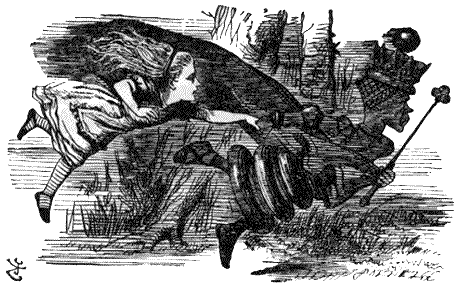
“It takes all the running you can do to keep in place!”
Perverse Price Incentives in
Higher Ed
and the Red Queen Effect
This post is a very important one for helping to understand the tuition/loan rat race and the mess it has led to...
President Bruininks - and your successor - please pay attention.
The university president I worked for had a colorful way of framing the problem. He would remind his administrative colleagues, “We don’t want to leave money sitting on the table.” What he meant was that if families could possibly pay more to attend our university, our duty was to capture that increment. A prime consideration was to make sure that those students eligible to get federal grants and to take out federally guaranteed student loans maxed out on these. If they didn’t, we were “leaving money on the table."
It is not hard to extrapolate from this to what happened and what still happens when the federal government increases the funds in a student grant or loan program, or lowers the conditions of eligibility, or otherwise acts to make college “more affordable.” In college and university administrative offices across the country, people start to calculate just how high they will now be able to set new prices to capture these additional resources. Mentioning this in the company of higher education’s official representatives, of course, elicits indignation. Perhaps somewhere there are college administrators so conniving that they would do such a thing, but not us. We are concerned primarily about maintaining access and affordability. Those increases in federal aid mean that students who could not otherwise attend college now will have that precious opportunity. They will have access because the government has helped make college more affordable.
Well, if you say so.
There is a paradox in government subsidies for higher education. Government subsidies for most goods tend to spur increases in supply and bring new competitors to the marketplace, and thus work to reduce prices. But government subsidies in higher education seem only to increase prices. That happens because American higher education is arranged in a fashion that makes it extremely difficult for new competitors to enter the field. When the federal government chooses to subsidize ethanol, more farmers plant corn in more fields. When the federal government subsidizes students, the number of colleges and universities remained basically static.I don’t want to be overly cynical about federal aid to students. I am sure that many of the politicians of both parties who over the years have favored increases in student aid imagined they were (mostly) helping students. And I have no doubt that college and universities administrators mostly see themselves as altruists whose pursuit of more income for their institutions is bound tightly to their commitment to use some of that income to fund scholarships for needy students. But benevolent motives aside, the system works very much like a treadmill. [The Red Queen Effect] No matter how fast we run, we stay in one place. Increasing student aid doesn’t make college more affordable; it just puts more resources in the hands of college administrators.Our current system of higher education in the United States is so deeply enmeshed with the federal student aid system that it is difficult to see how we could ever get off the treadmill. Treadmills, however, don’t run forever, and this one is showing its age. We need to give some serious thought to developing new federal policies that can sustain the crucial parts of American higher education while eliminating the perverse incentives to higher prices.
Sunday, November 7, 2010

Presidential Search
On Friday, a search advisory committee recommended four candidates to the regents, who will consider them and then publicly name finalists.
At that point, it will become clear whether the U can attract academic superstars for its top job at a time of shrinking resources and growing expectations -- especially if it must endure a public vetting of the finalists.
"You really have a limited pool of people right now," said Rita Bornstein, president emerita of Rollins College in Florida and an expert on higher education leadership. Because of big challenges to universities, including state funding cuts, "most boards are looking for someone who has experience being a president." That's not an easy feat.
But Clyde Allen, regents chairman, said there's "a strong pool."
According to the job description, he or she must be "a creative fundraiser," a "skilled planner and budgeter," an "effective communicator" and a "politically astute leader."
Making the head hunt harder is that the U is a public institution, and state law demands that names of finalists be public. That makes recruiting sitting presidents of other institutions -- a goal of the U's search -- "very, very challenging," said Bornstein, because such candidates might worry about souring relations at their current spot.
Some faculty members, however, have challenged the need for secrecy and point out that a public forum means more people have a chance to vet the candidates.
In 2002, after secretly interviewing several candidates netted in a national search, the regents rejected the search advisory committee's recommendations and chose Bruininks, then serving as interim president.
In that search, as in others across the country, the public university weighed transparency against privacy.
In contrast, the University of Minnesota's search, so far, has been conducted privately. Candidates will become public only once the regents select them as finalists.
That's more than reasonable, said Jane Kirtley, director of the U's Silha Center for the Study of Media Ethics and Law.
"If you're going to be the president of a public university, one of the first things you have to accept is that you're going to be subject to public oversight," she said. "You might as well get used to it."
Allen has said that if one candidate comes out "head and shoulders" above the others, the board might pick just one finalist.
That possibility -- one Allen now calls unlikely -- has worried some. "We're talking about a land-grant university, a university that survives to a great extent on taxpayer dollars," Kirtley said. "The public literally has a right to know how this search process is being conducted."
Such a tactic would also deny professors and students a chance to participate in the decision, said William Gleason, a faculty member in the Department of Laboratory Medicine and Pathology. "They are going to get egg on their face if they try to pull that," he said.
In 2004, the Minnesota Supreme Court ruled that the regents violated the state's Open Meeting Law and Data Practices Act by interviewing finalists in secret, refusing to release their names. Several media organizations sued to force release of those names, and the U eventually complied.
General Counsel Mark Rotenberg has said in this search, the U will "live within the Supreme Court's decision." Naming one finalist would not violate the law.
Allen said his comments were meant to simply alert people to the possibility that one candidate could come out on top. But that's a slim possibility, he said. "I expect that there would be a number of finalists," he added.
The board seems to be staying "flexible," which is appropriate, said Kathryn Vandenbosch, chair of the Faculty Consultative Committee. A top-notch candidate, worried about his or her job now, might request to be the only finalist considered. Vandenbosch said she trusts the board to make that call. "I certainly have a high level of trust that they will sift out the best of the best," she said.
I do not share Professor Vandenbosch's optimism.
One of the members of the Board of Regents was extensively quoted in the Pioneer Press recently about the search for a new football coach.
What he had to say is disturbing for two reasons.
First, it appears that he has distorted priorities and a faulty understanding of the concept of outreach, at least at a university.
Second, he makes laudatory remarks about a failed president at another university without apparently realizing the dismal job this person has done. That someone, who is so unaware of the academic landscape and of what makes a good (or a bad) university president, is involved in selecting our next president is very disturbing.
Given the composition of the search committee, it is hard to believe that the Board of Regents has the expertise to remove one or more of the semi-finalists from the list.
Of course one or more of the semi-finalists may choose not to be a finalist because of the publicity. I can live with this and if that is the reason it should be so stated. The search committee should have made it clear that this was an open search - at least at the end - and that names would have to be named. If someone withdraws for this reason, it does not reflect well on the search committee. I remind people who make a big thing of this problem, that the U's Dr. Robert Jones was a finalist for the presidency of the University of Hawaii - and an excellent one. This does not appear to have impaired his ability to function here at Minnesota.
Let's put all the cards on the table this time.
+++
Subscribe to:
Posts (Atom)